
6 Traceability Software Solutions for Luxury and Precious Materials in 2026
6 traceability software solutions compared for watches, jewellery and precious materials: blockchain, DPP, lot splitting, OECD, G7 and EmpCo compliance.
 Guy De Smet
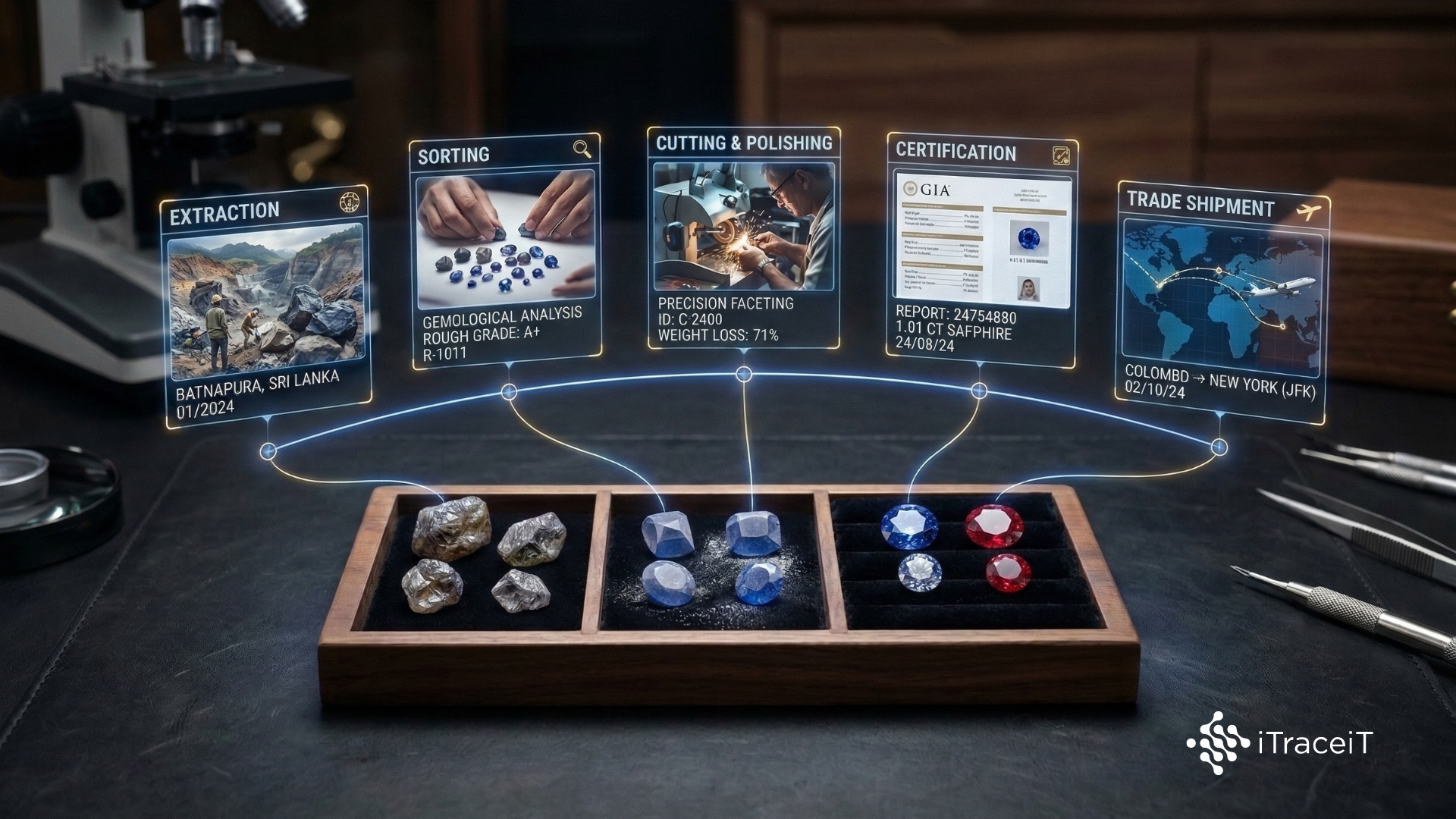
For a jewellery house, a watchmaker or any company working with precious materials, knowing where a product comes from is no longer enough.
Businesses increasingly need to connect origin with transformation, certification and every actor involved along the way, without compromising the integrity of that information.
The regulatory landscape is reinforcing that need. Since 27 September 2026, the EU EmpCo Directive has introduced stricter rules around environmental claims and sustainability labels. In the natural diamond sector, European restrictions linked to Russian origin also rely on traceability evidence.
But not all traceability software addresses the same need: some focus on supplier compliance, others on the digital passport of the finished product, and still others track the raw material from its origin, including when it is divided or recombined. And for companies that also have leather goods or ready-to-wear lines, the textile and leather supply chains are added to the equation.
Here are six platforms to know in 2026, what each one is designed to do and where it is best suited.
The right traceability software depends on what you need to prove.
How did we compare these solutions?
This comparison is published by iTraceiT. Information about the other platforms is based on their publicly available documentation and on industry or institutional sources consulted in October 2026.
This is not an absolute ranking. Each platform is designed to solve a different set of challenges. We compared them against six questions that are particularly relevant to luxury and precious-material supply chains:
Industry coverage
Which sectors and materials does the platform actually cover?
Regulatory frameworks
How does it support requirements related to the OECD Guidance, RJC Chain of Custody, G7 measures, ESPR and the Digital Product Passport?
Data integrity
Are records timestamped and protected against subsequent alteration?
Lot management
Can the platform follow transformations, splits and merges?
Integrations
Can it exchange data with ERP, PLM, laboratories, certifiers and other systems already in use?
Geographical context
Can the platform operate in producing countries and across very different operational environments?
Which traceability solutions are relevant to luxury?
iTraceiT — blockchain-secured traceability from raw material to finished product for diamonds, gemstones, precious metals and luxury goods.
Tracr — blockchain platform for natural diamond provenance, with registration at source.
Arianee— open Digital Product Passport infrastructure for product identity and lifecycle management.
TrusTrace — supplier-data collection and structuring platform for fashion, footwear and textiles.
Retraced— supplier-data infrastructure and compliance management for fashion and textiles.
Everledger —blockchain traceability for diamonds, gemstones and high-value assets, restructured in 2023.
The 6 luxury traceability software solutions in detail
iTraceiT: end-to-end traceability for precious materials and luxury
At a glance.iTraceiT is a cloud-based end-to-end traceability platform fordiamonds, gold, gemstones and luxury products..Its permissioned blockchain infrastructure connects origin, transfers, transformations, lot splits and merges in a timestamped, verifiable history from raw material to finished product.
Built for supply chain and compliance teams, the platform structures the data needed to support processes related to the RJC Chain of Custody, OECD Guidance, G7 measures, ESPR and the European Digital Product Passport. Traceability data can also feed brand-side digital product passports, creating continuity between upstream supply-chain information and the finished product.
Independent from any producer, brand or industry consortium, iTraceiT allows companies to retain control over their data and decide what information is shared with each stakeholder.
Features- End-to-end blockchain traceability : every transfer, transformation, lot split or merge remains connected to its origin in a timestamped, verifiable history.
- Lot split and merge management : when a lot is divided, each resulting lot retains its link to the original source. When several lots are merged, their histories remain associated with the new lot.
- Multi-standard compliance support : iTraceiT helps structure the data required for processes linked to the RJC Chain of Custody, OECD Guidance, G7 measures, ESPR and the Digital Product Passport.
- Digital Product Passport integration : through its technical collaboration with Aura Blockchain Consortium, iTraceiT can automatically transmit traceability data on melee diamonds to Aura digital passports and tokens.
- API and integrations : traceability data can connect to ERP, LIMS, certification systems and other existing tools through a documented REST API and test environment.
- Web applications : operators can scan QR codes, add images or documents and update lot information directly from the field.
- Granular access control : each organisation decides which data can be viewed or shared with different actors across the chain.
- Digital identity and verifiable product storytelling : traceability data can power a QR-code experience that presents the product journey to the end customer based on recorded information.
- - The depth of the platform may require an initial configuration and onboarding phase for teams.
- - Advanced capabilities such as notarisation or complex transformation workflows deliver the greatest value in supply chains involving multiple actors, stages or evidence requirements rather than low-volume operations.
- - API integrations require coordination with internal IT teams or relevant system providers during the initial deployment.
Tracr: specialised traceability for natural diamonds
At a glance. Tracr is a blockchain platform dedicated tonatural diamond traceability,, from registration at source through to the polished diamond. Each registered stone receives a digital identity that documents its origin, transformations and journey through the value chain.
Originally developed by De Beers and later opened more broadly to the industry, Tracr operates as sector-specific infrastructure for natural diamonds. Its model brings together producers, laboratories, manufacturers and commercial actors to strengthen continuity of provenance data across the chain.
Features- Registration at source: diamonds are registered at origin to create a digital identity linked to their provenance.
- Rough-to-polished traceability: stages between the rough diamond and the polished stone can be linked to its digital journey.
- Blockchain infrastructure:recorded data is stored in a secure history designed to preserve its integrity.
- GIA integration: selected Tracr provenance information can be linked to GIA grading reports.
- Access to provenance data: supply-chain participants can consult recorded information about a diamond’s origin and journey.
- - The platform is centred on natural diamonds, without equivalent coverage for gold, coloured gemstones, watches or other materials.
- - It is less suited to companies that need to manage several categories of materials within one infrastructure.
- - Its origins within De Beers may remain a consideration for companies that prioritise a fully independent platform.
Arianee: open Digital Product Passport infrastructure
At a glance. Arianee is a platform focused on theDigital Product Passport (DPP) and product digital identity. It combines a SaaS platform with a decentralised, open protocol that enables brands and manufacturers to create, manage and distribute interoperable digital passports.
With a strong presence in luxury, fashion and consumer goods, Arianee covers DPP compliance, product lifecycle management and interactions with the product owner or user.
Features- DPP creation and management: creation, validation, updating and publication of digital passports that bring together regulatory information and product data.
- Open protocol: digital identifiers can be anchored on the Arianee infrastructure in order to preserve their integrity and interoperability.
- Cloud architecture: infrastructure designed to manage digital passports and their data at scale.
- DPP and ESPR compliance: tools to structure and control the information required for future regulatory product passports.
- APIs and integrations: APIs and connectors designed for enterprise systems.
- Lifecycle management: the passport can record repairs, ownership transfers, updates, refurbishment and end-of-life information.
- Post-purchase experience: the DPP can become a touchpoint for warranties, services, resale, authentication and customer engagement.
- - Arianee is primarily centred on the digital passport, product identity and lifecycle, rather than detailed traceability of raw materials from origin.
- - For companies that need to document the origin and successive transformations of materials such as gold, diamonds or gemstones, upstream data needs to be integrated into the passport from the actors or systems that collect it.
- - Its approach is multisectoral and is not specifically built around the chain-of-custody, lot-splitting or lot-merging workflows found in some precious-material supply chains.
TrusTrace: supplier data for fashion and textiles
At a glance. TrusTrace is a supply-chain traceability and compliance platform designed primarily for fashion, textiles and footwear. It collects, structures and links supplier data to give brands multi-tier visibility into material origin, product flows and compliance evidence.
The platform combines supplier mapping, upstream traceability, document collection and AI-powered automation to centralise the information needed for risk management, product claims and regulatory requirements.
Features- Multi-tier traceability: tracking of materials and products across different tiers of the supply chain.
- Supplier mapping: identification and structuring of direct and indirect suppliers.
- AI-assisted collection and validation: extraction and structuring of information from certificates, audits, reports and other supplier documents.
- Chain-of-custody management: collection and connection of evidence needed to document material flows and claims related to origin or sustainability.
- Regulatory compliance: modules designed to structure the data required for different regulatory frameworks and market requirements.
- Digital Product Passport: generation of product identifiers, QR codes and interfaces that connect traceability data to the DPP.
- APIs and integrations : connection of traceability data with other enterprise systems.
- -TrusTrace is primarily designed forfashion, textile and footwear supply chainsand is not specifically oriented around jewellery, watchmaking or precious-material workflows.
- - Its approach relies heavily on collecting, validating and connecting supplier data and compliance documents rather than on a blockchain ledger designed to create an immutable transaction history.
Retraced: supplier compliance for fashion
At a glance. Retraced is asupply-chain traceability and compliance platform designed primarily for fashion and textiles. It centralises supplier, product, certification and risk data to help brands map their supply chains, manage compliance and collaborate with partners within a single infrastructure.
Its positioning combinesSupplier Lifecycle Management, multi-tier traceability, risk management, AI-powered automation and Digital Product Passport capabilities,, with a strong focus on sourcing, compliance and sustainability workflows.
Features- Multi-tier traceability: mapping of the supply chain from finished product back to raw material.
- Supplier management: centralisation of supplier profiles, contacts, certifications, documents and compliance information.
- AI-assisted risk assessment: generation of risk profiles and identification of critical points based on ESG factors, documents and supplier data.
- Audit and certificate management: collection, validation and monitoring of audits, certificates and supporting documents.
- CAPA and corrective actions: creation and tracking of corrective and preventive actions with suppliers.
- Digital Product Passport: traceability and compliance data can be used to feed DPPs.
- ERP, PLM and integrations: supplier and product data can be integrated into existing ERP, PLM and DPP workflows.
- - Retraced is primarily designed forfashion and textile supply chainsand is not specifically oriented around jewellery, watchmaking or precious-material workflows.
- - Its approach centres on the collection, validation and collaborative management of supplier data rather than on a blockchain ledger designed to make traceability events immutable.
Everledger: digital records for diamonds and gemstones
At a glance.traceability and digital identity platform. historically focused on diamonds, gemstones and other high-value assets. It combines blockchain, digital identifiers and authentication technologies to document an asset’s origin, ownership, characteristics and related events throughout its journey.
The current scope of its services should be confirmed directly with the company.
Features- Digital asset identity creation of a unique record linked to the characteristics and history of a diamond, gemstone or other object.
- Blockchain records: provenance and ownership events are added to a blockchain ledger to preserve the integrity of the history.
- Product authentication: tools designed to connect the physical object with its digital record.
- API: interfaces that allow provenance, compliance and chain-of-custody data to be integrated into other systems.
- - Corporate evolution: Everledger underwent a restructuring of some of its entities in 2023. For long-term projects, it may be useful to confirm the contractual and operational structure applicable to the service under consideration.
- - The platform covers several asset categories, but its public solutions are particularly focused on individual asset identity, provenance and authentication, rather than on detailed management of complex industrial transformations.
Comparison table: luxury traceability software
Assessment based on official websites and the sources listed at the end of this article, consulted in October 2026.
| Platform | Primary sector | Blockchain | Upstream coverage | Split / merge | DPP | Integrations | Best suited for |
|---|---|---|---|---|---|---|---|
| iTraceiT | Precious materials, luxury | ● Yes Permissioned blockchain | ● Yes | ● Yes | ● Yes | API, ERP, LIMS, certification | Multi-material supply chains and complex transformations |
| Tracr | Natural diamonds | ● Yes | ● Yes | ○ Partial | ○ Partial | API, GIA integration | Natural diamonds at scale |
| Arianee | Multisector, DPP | ○ Partial Open protocol | ○ Partial | — Not covered / not documented | ● Yes | API, ERP, PIM | Product passports and post-purchase engagement |
| TrusTrace | Fashion, footwear, textiles | — Not covered / not documented | ● Yes Fibres | ○ Partial | ● Yes | API and enterprise systems | Textile supplier compliance |
| Retraced | Fashion, textiles | — Not covered / not documented | ● Yes | ○ Partial | ● Yes | ERP, PLM, DPP | Supplier audits and certificates |
| Everledger | Diamonds, gemstones | ● Yes | ○ Partial | — Not covered / not documented | ○ Partial | API | Asset identity and provenance; current scope to be confirmed |
Which traceability solution is right for your profile?
The right tool depends on where you sit in the value chain and what you need to prove.
How does blockchain traceability strengthen ESG compliance in luxury?
Compliance requirements are pushing luxury businesses to document the origin, transformation and certification of their materials and products more rigorously.
Blockchain adds an additional layer of integrity to that documentation: each recorded event can be timestamped and preserved in a history protected against subsequent alteration.
For compliance teams, the benefit is also practical. Instead of reconstructing a product journey from documents scattered across suppliers, laboratories, certifiers and logistics partners, information can be connected within a single traceability history.
This level of granularity helps companies prepare the data required by frameworks such as the OECD Guidance, G7 measures concerning diamonds of Russian origin and, where relevant, future European Digital Product Passport requirements.
What distinguishes reliable traceability software for watches and jewellery?
Transformation management
Materials rarely move through a supply chain in a straight line.
A lot of rough diamonds may become several polished stones. Multiple metals may be combined into an alloy. A finished piece may bring together components from entirely different supply chains.
The platform must preserve the history through each of these transformations.Data quality and governance
Traceability technology is only as valuable as the data that feeds it.
Companies need to understand who can add information, who can amend it before validation, who controls it and what evidence can be attached at each stage.
Interoperability
Infrastructure that works only within its own environment creates another silo.
It should be able to exchange data with the ERP, PLM, laboratories, certifiers, logistics partners and other platforms already present in the supply chain.
Controlled data sharing
Transparency does not mean making every piece of data public.
Companies need to be able to demonstrate provenance or compliance while protecting commercially sensitive information.
Real supply-chain coverage
A platform designed for a global supply chain also needs to work where the data originates, including producing countries and operational environments where digital infrastructure may be more limited.
What changed with the EmpCo Directive on 27 September 2026?
2026 · Directive (EU) 2024/825 Directive (EU) 2024/825 has applied since 27 September 2026. TThe new rules place stricter controls on certain generic environmental claims and sustainability labels.
For jewellery houses, this reinforces the importance of connecting claims to verifiable information and supporting evidence. A lot history linked to third-party certificates can help structure that documentary evidence.
Which luxury traceability software should you choose in 2026?
Each platform in this comparison serves a distinct purpose.
TrusTrace and Retraced primarily focus on supplier compliance and supplier data in fashion and textiles. Arianee focuses on digital product passports, product identity and post-purchase engagement. Tracr specialises in natural diamond traceability, while Everledger has historically focused on digital identity and provenance for diamonds, gemstones and other high-value assets.
iTraceiT was designed to trace precious materials from mine to finished product, including through splits, merges, transformations and transfers between actors.

If that reflects your supply chain, book a demo to see how iTraceiT can structure your traceability data and workflows.
FAQ: luxury traceability software
It is a tool that records the journey of a product or material from origin to sale, including transfers, transformations, certifications and other events associated with its lifecycle. It structures provenance information for auditors, buyers, partners or consumers.
Traceability documents the journey of a material or product through the supply chain. A DPP is a digital record attached to the finished product and designed to bring together the information required by the applicable regulatory framework. A DPP can draw on traceability data collected upstream.
No. Blockchain protects the integrity of data after it has been recorded. The accuracy of that data still depends on its source, the controls applied at entry and the evidence or certifications that support it.
Not at this stage. The first ESPR Working Plan for 2025–2030 includes categories such as textiles, steel, aluminium, furniture, tyres and mattresses, but does not currently include jewellery or watches.
Look in particular at how the platform manages lot splits and merges, the countries in which it can operate, data ownership and sharing controls, and how it integrates with your existing systems.
A sector-specific solution can be a strong fit when a company operates within a highly specialised value chain, such as natural diamonds. If your supply chain combines multiple materials, products or transformations, a multisector platform can help centralise traceability rather than layering several separate tools.
It depends on the existing infrastructure, the scope of the integration and the APIs available. iTraceiT provides partners with a documented REST API, a test environment and integration support.
Sources
- 01 GIA – GIA and Tracr, 29 May 2026
- 02 Arianee - Protocol
- 03 Arianee
- 04 TrusTrace
- 05 Retraced
- 06 Ledger Insights – Everledger, 2023
- 07 JCK – Everledger to Restructure Following Funder Fallout
- 08 Sidley – European Commission Releases List of Priority Products for Ecodesign Requirements
- 09 European Commission – Directive (EU) 2024/825